UV Lures Explained: What UV Reflectance Is and When It Actually Works
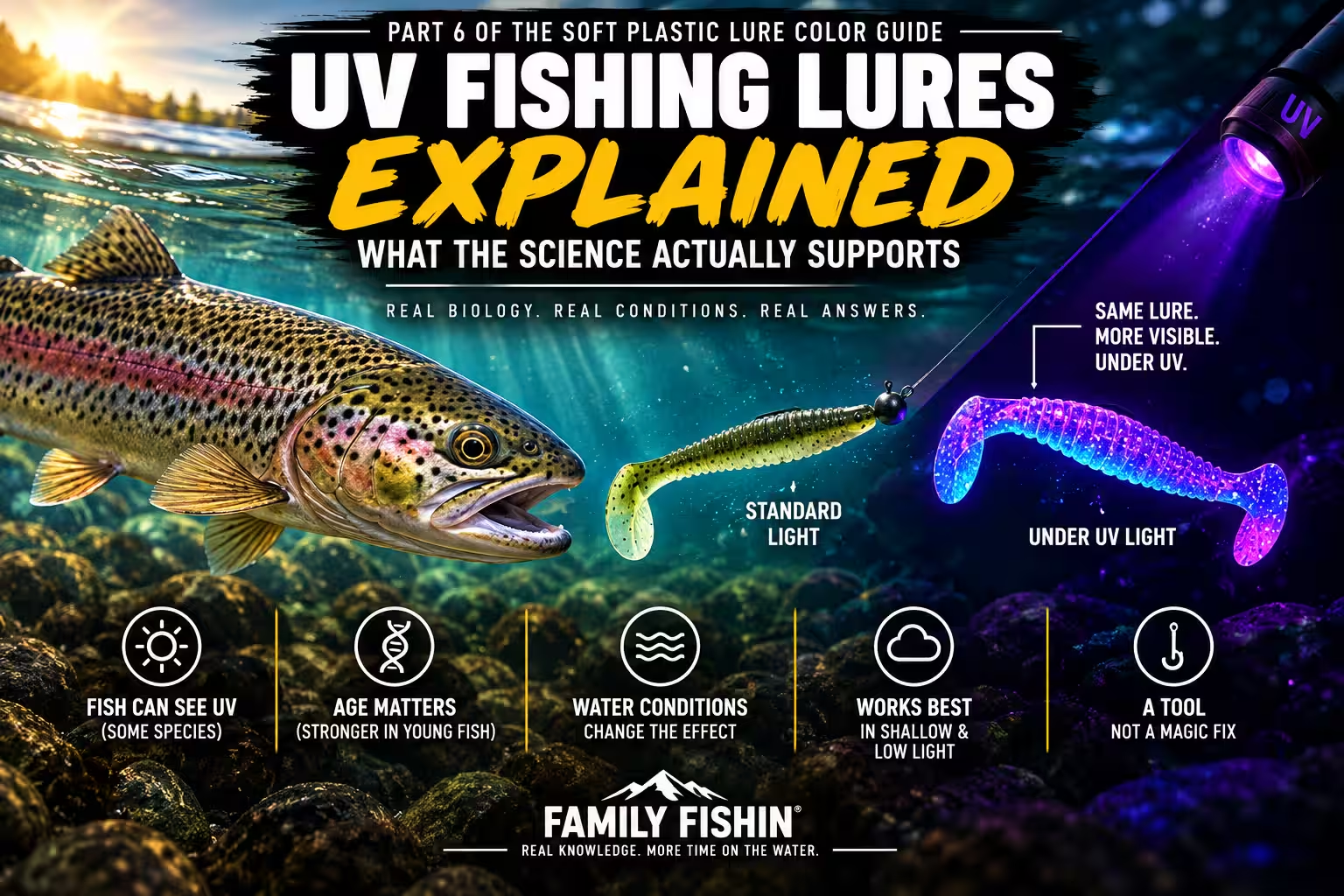
Part 6 of the Soft Plastic Lure Color Guide
UV fishing lures generate more debate than almost any other topic in tackle selection. Some anglers treat UV enhancement as a secret weapon that outperforms everything else in the box. Others dismiss it outright as a marketing gimmick — a glow-in-the-dark sticker with better branding. Both positions are overstating something the research actually supports in a narrower, more specific way. UV vision is real, documented, and measurable in several freshwater species, including trout. What it isn’t is a universal upgrade that works the same way in every condition, on every species, at every stage of a fish’s life. This part of the series lays out what’s actually established, where the common claims about UV hold up, and where they need correcting.
What “UV-Enhanced” Actually Means in a Lure
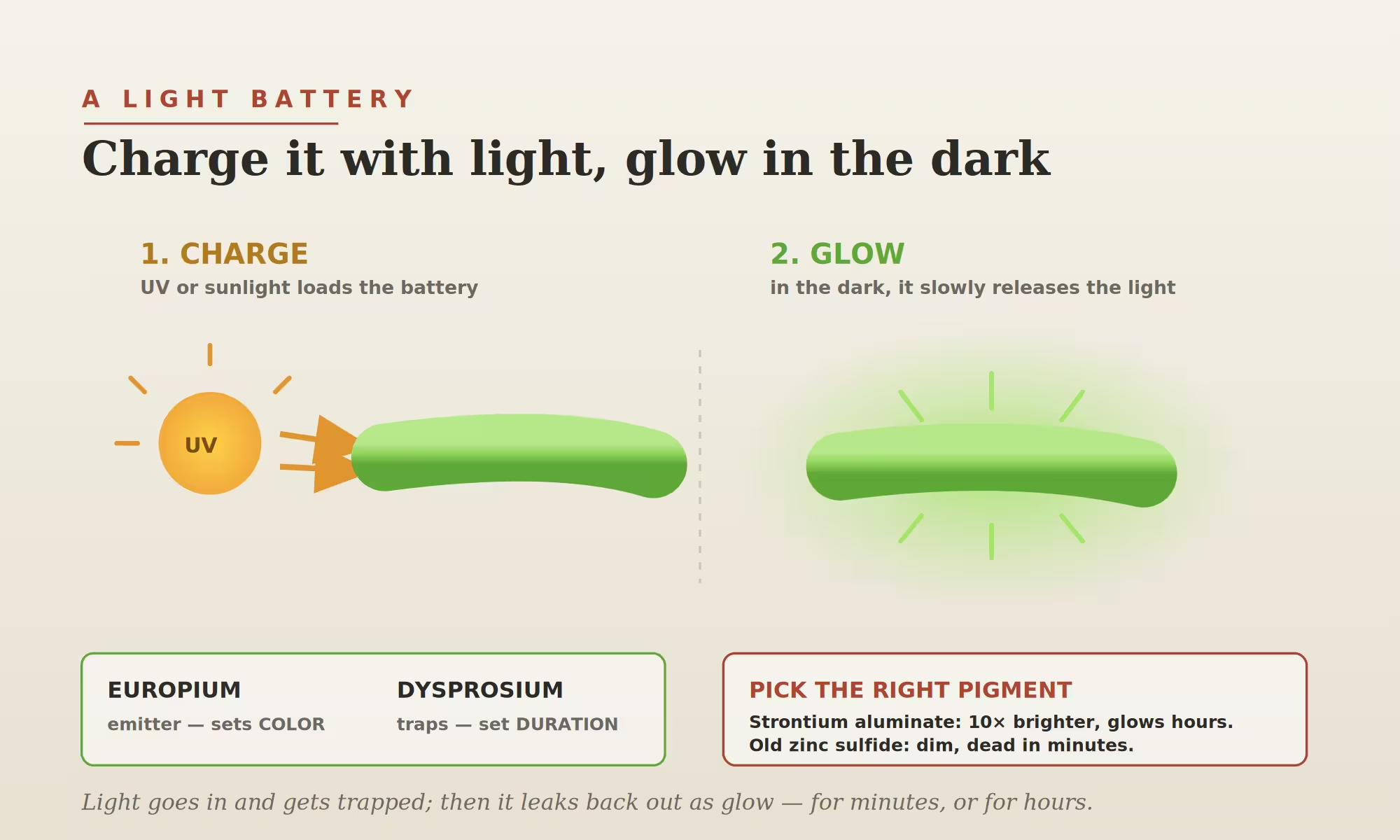
There’s a mechanical distinction buried inside “UV lure” that most tackle marketing collapses into a single idea, and untangling it resolves a lot of the apparent contradiction between the trout research, the bluegill research, and the angler field reports above. Most UV-reactive lure finishes don’t work by reflecting ultraviolet light back out as ultraviolet light. They work through fluorescence: the material absorbs UV energy and re-emits it at a longer wavelength, typically in the visible blue or green range — the same basic mechanism used in optical brighteners added to paper and fabric to make white look whiter, and the reason a “UV” lure often glows under a blacklight even though nothing about that glow is itself ultraviolet light.
This distinction matters because it means a fluorescent UV-reactive finish is doing two different things for two different audiences at once. For a species with a UV-sensitive cone — trout, most directly — the finish may also be reflecting some genuine UV light that the fish’s UV cone can detect as a distinct signal, on top of whatever fluorescence is happening. For a species without UV-sensitive cones — bluegill’s juvenile UV photoreceptors aside, most gamefish fall into this category — the fluorescence itself is still doing something real: it’s converting invisible UV energy into extra visible-light brightness and contrast that any fish’s ordinary cones and rods can pick up, the same way a fish would respond to any unusually bright or high-contrast lure, UV involved or not.
This reframes what’s actually happening in the bluegill research discussed above. The controlled study measuring UV radiation’s effect on foraging was testing true UV detection — whether the fish’s photoreceptors were using UV wavelengths directly as a foraging cue. It wasn’t testing whether a fluorescent lure finish, glowing brighter under available UV, produces more strikes through simple added visibility. Those are different mechanisms, and a lure finish can be genuinely effective through the second one even in a species where the first one shows no measurable benefit in a lab. It’s also worth being direct about what this means for evaluating a “UV lure” honestly: some of what gets sold under that label is exploiting a true species-specific UV visual channel, and some of it is exploiting ordinary visible-light brightness by way of a UV-to-visible conversion trick — both are legitimate, but they’re not the same claim, and only the first one depends on the fish having UV-sensitive vision at all.
Some Fish Can See Light Humans Can’t
Ultraviolet light sits just below 380 nanometers, outside the range of wavelengths the human eye can register at all. Human color vision runs on three cone types spanning roughly 420 to 560 nanometers — we simply don’t have the hardware to detect anything shorter. A number of fish species do. Part 4 of this series covered the specific case in the greatest depth: rainbow trout carry a fourth cone type, a UV-sensitive cone, with peak sensitivity measured directly at around 378 nanometers, on top of the three cones (blue, green, and yellow-red sensitive) that roughly parallel human trichromatic vision. That fourth channel gives trout access to a genuine visual signal that has no equivalent in the human eye — not a stronger or dimmer version of a color we can already see, but information from a part of the spectrum we can’t perceive under any lighting condition.
Trout aren’t unusual among fish in having this capability — UV photoreceptors have been documented across a wide range of freshwater and marine species, which is one of the reasons researchers consider UV sensitivity a fairly prominent feature of aquatic visual ecology generally, not an isolated trout curiosity. Bluegill, a common panfish species, carry documented UV photoreceptors as juveniles as well, a point covered in more detail below because the research on what that sensitivity actually does for a bluegill’s foraging is more mixed than the trout research and worth being precise about.
The fact that UV photoreceptors show up this broadly across unrelated fish lineages is itself informative. Independent evolution of the same sensory capability across distantly related species generally signals that the capability is solving a recurring survival problem rather than being an evolutionary accident — in this case, most likely detecting prey, avoiding predators, or identifying mates against a UV-rich upper water column where that signal is genuinely present and usable. That’s a reasonable basis for taking UV vision seriously as a real ecological factor, without needing to overstate how much any individual angling decision should hinge on it.
There’s also a biological reason UV sensitivity shows up as often as it does: it isn’t just useful for spotting objects lit up against a UV-bright background. Many small aquatic organisms — baitfish, plankton, and other prey species — reflect UV light as a natural property of their scales and skin, sometimes as camouflage in the UV range, sometimes as part of species recognition or mate signaling. A predator with a UV-sensitive cone isn’t inventing a new signal out of nothing when it responds to UV-reactive material — it’s tapping into a channel that’s already carrying real information about what’s actually in the water, the same way a green-sensitive cone is tapping into a wavelength that vegetation and certain baitfish patterns are already reflecting.
UV Sensitivity Isn’t Fixed — It Changes With Age
This is the piece of the UV conversation that gets left out of most tackle-shop explanations, and it matters enough to cover directly rather than as a footnote. UV cone sensitivity in trout is not a fixed trait present at full strength throughout a fish’s life. Research tracking the ontogeny — the developmental trajectory — of UV photosensitivity in rainbow trout has found that UV sensitivity is strongest early in life and declines as the fish matures. A parallel line of research on brown trout describes the same pattern directly: age-dependent changes in the tetrachromatic visual system, with UV receptor prominence shifting over the fish’s lifespan rather than staying constant.
By adulthood, trout retain only a fraction of the UV sensitivity present in their earliest life stages — a secondary mechanism partially compensates, but research indicates it recovers only roughly a quarter to a third of what full UV cone function originally provided. This doesn’t mean UV becomes irrelevant to an adult trout — the channel is still there and still functional, just diminished relative to a juvenile fish. It does mean that “trout can see UV” is true but incomplete as a statement, in the same way “trout are tetrachromatic” is true but doesn’t tell you whether the fish in front of you is drawing heavily on that fourth channel or barely using it. A stocked fingerling and a mature holdover trout in the same pool are not working with identical visual equipment, even though both are technically UV-sensitive.
What the Bluegill Research Actually Found
Bluegill are worth a dedicated section here because the research is a useful case study in why “this species has UV photoreceptors” doesn’t automatically mean “UV enhancement will improve your catch rate with this species.” Juvenile bluegill do carry documented UV photoreceptors, and it would be reasonable to assume that translates into a foraging advantage under UV light — more visible prey, longer detection range, more successful strikes. A controlled feeding study tested exactly that, measuring sighting distance, striking distance, and capture success for juvenile bluegill foraging on zooplankton under UV-present and UV-absent lighting conditions. The result: none of those measures differed meaningfully between the two lighting conditions. The bluegills in that study weren’t foraging any better with UV radiation present than without it, at least on the prey size and life stage tested.
That’s a genuinely useful data point precisely because it complicates the simple version of the UV story. Having the receptor doesn’t automatically mean the fish is relying on it for the specific task being measured — foraging on small zooplankton, in that case. It’s also a reminder that angler-reported field results (several panfish-focused sources describe UV finishes producing more strikes, including in bright, clear daytime conditions where UV theory would predict less of an advantage) and controlled laboratory research don’t always point the same direction, and both are worth weighing rather than picking whichever one supports a preferred conclusion. The honest state of the bluegill evidence is mixed: real photoreceptors, angler field reports of results, and at least one controlled study that didn’t find a measurable foraging benefit under the specific conditions it tested.
There’s a reasonable reconciliation between those seemingly conflicting bluegill data points, and it connects directly to the fluorescence mechanism covered in the next section: field-reported bluegill success on “UV” baits may be driven less by the fish’s UV photoreceptors specifically and more by the added visible-light brightness those baits produce through fluorescence — a mechanism that would work on a bluegill’s ordinary cones regardless of whether its UV photoreceptors were contributing anything at all. That doesn’t resolve the question definitively, but it does explain how a species can show angler-reported success with UV products alongside a controlled study finding no measurable UV-specific foraging benefit, without either observation being wrong.
Cloud Cover and UV: What’s Actually True, and What It Doesn’t Mean
One claim shows up constantly in UV lure marketing and deserves a careful, corrected explanation rather than a repeat of the shorthand version: that UV light “penetrates cloud cover better than visible light.” As stated, that’s a real, measurable atmospheric phenomenon — it’s just being applied to the wrong part of the journey light takes before it reaches a fish.
Clouds are considerably less effective at blocking ultraviolet radiation than they are at blocking visible light. Depending on cloud type and thickness, up to 50 to 90 percent of UV radiation can still pass through overcast skies, and thin or scattered cloud cover can leave UV levels nearly unchanged from a clear day — occasionally even higher, due to UV scattering off cloud edges. Visible light, by contrast, is cut much more substantially by the same cloud cover; a fully overcast sky commonly transmits roughly half of the visible light a clear sky would, sometimes less. That gap is real, well-documented atmospheric science, and it means that on an overcast day, the ratio of UV to visible light reaching the water’s surface genuinely does shift toward relatively more UV than a sunny day would provide.
Where the claim needs correcting is what happens next. That atmospheric comparison describes light arriving at the water’s surface — it says nothing about what happens once that light enters the water itself, which is a separate physical process with its own rules, covered in Part 5. UV is a short wavelength, but it does not penetrate water as far as the blue and green wavelengths sitting just above it on the spectrum; water’s own absorption rises again below the blue absorption minimum, cutting into the UV range. So the accurate version of this claim is narrower than “UV works better on cloudy days” as a blanket statement: cloud cover shifts the available light toward relatively more UV at the surface, which can matter in shallow water and the upper part of the water column where that UV signal is still intact — but it doesn’t change the fact that UV fades out faster than blue or green light does as depth increases, cloud cover or not.
When UV Fishing Lures Actually Help
Pulling the corrected pieces together, UV-enhanced lures have a genuine, biology-backed advantage in a specific, definable set of conditions rather than universally:
- Shallow water, in general. UV light — from the sun directly or the more UV-heavy mix present on overcast days — is strongest near the surface and fades with depth faster than the visible wavelengths covered in Part 5. This is the single condition UV enhancement depends on most directly: without meaningful UV in the water to begin with, a UV-reactive finish has nothing to react to.
- Overcast conditions, specifically in that shallow-to-moderate zone. The atmospheric UV-versus-visible ratio genuinely shifts toward UV on cloudy days, and in the depth range where that surface-level UV is still present in the water, that shift can give a UV-reactive bait a real edge over a standard color that’s losing contrast as overall visible light drops.
- Stained water, within limits. Reduced clarity compresses visible-light detection range the way it does for every color discussed in Part 5, and a UV signal can extend usable detection range somewhat beyond what standard visible color offers in that same water — though stained water’s dissolved organics also cut into short wavelengths generally, so this isn’t an unlimited advantage.
- Younger, UV-sensitive fish specifically. Given the age-dependence covered above, UV enhancement is working with a stronger, more intact sensory channel in younger trout than in older, mature fish — a distinction the broad “trout can see UV” claim leaves out entirely.
Our Ribbed Trout Worm offers Bright/UV colors alongside natural and dark tones specifically for this kind of stained-water situation, so you can match the color to the water instead of guessing.
When UV Doesn’t Matter Much
The same biology that supports UV in the conditions above argues against leaning on it in others:
- Real depth. Once a presentation is deep enough that UV has attenuated out of the water — which happens faster than for blue or green light — a UV-reactive finish has no wavelength left to work with, the same way a red lure has nothing left to reflect at depth.
- Bright, clear, midday conditions. This is a case where more light doesn’t mean more UV advantage — it means visible-spectrum cone vision (covered in Part 4) is operating at its best, and standard color accuracy and contrast are doing more of the work than a supplemental UV signal that isn’t adding much when everything else is already clearly visible.
- Mature fish with reduced UV sensitivity. As covered above, an older trout is not drawing on the same UV channel strength as a juvenile, which tempers how much benefit UV enhancement can realistically deliver regardless of water conditions.
- As a substitute for getting depth and presentation right. This is the least biological and most practical point on the list, but it’s the one anglers most often get backwards: no amount of UV reactivity fixes a lure fished at the wrong depth, with the wrong action, or in front of fish that aren’t feeding. UV is influencing whether a properly presented lure gets seen — it isn’t a separate lever that compensates for the presentation being wrong in the first place.
Reading a Product Label Honestly
Given the fluorescence mechanism covered above, it’s worth knowing what to actually look for when evaluating a “UV” product rather than taking the label at face value. A finish described as UV-reactive, UV-enhanced, or glow-under-blacklight is very likely working primarily through fluorescence — converting UV energy into added visible brightness — which is a real, useful property for any species, independent of whether that species has UV-sensitive cones. A finish or material specifically engineered to reflect UV wavelengths without converting them to visible light is a narrower, less commonly marketed category, and its effectiveness depends entirely on whether the target species has the receptor to detect it, which for freshwater gamefish in this series means trout specifically among the species with the strongest documented case.
Neither category is inherently better than the other — they’re solving different problems. A fluorescence-based UV finish is a brightness and contrast tool that works broadly across species and doesn’t depend on UV-specific vision at all. A true UV-reflective finish is a narrower, species-dependent tool that only pays off with fish that can actually perceive that wavelength as information. Most commercial “UV” tackle blurs the two together in its marketing copy, but the practical difference is worth keeping straight when deciding how much weight to put on a UV claim for a given target species and set of conditions.
Material Choices Behind a UV-Reactive Soft Plastic
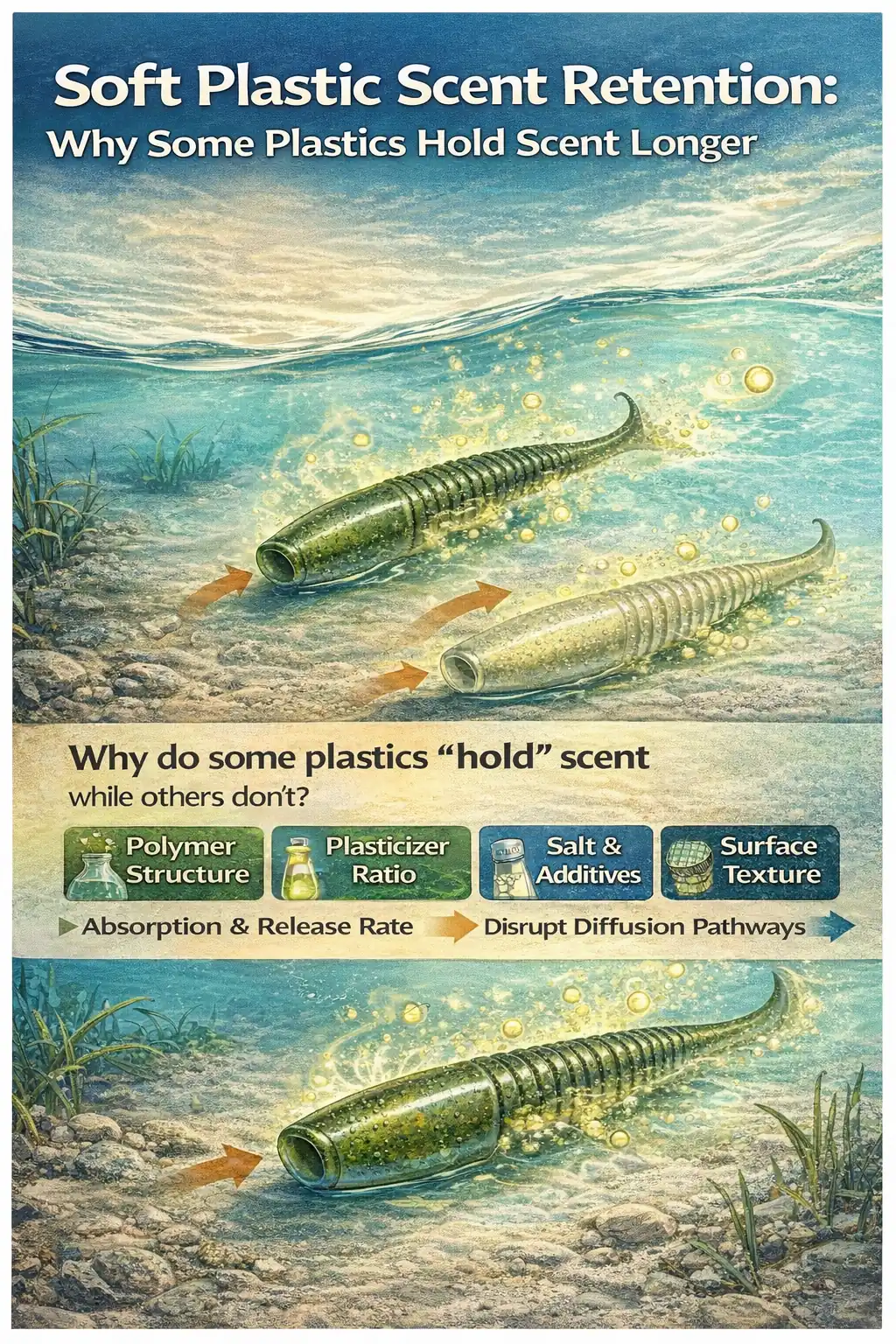
Getting fluorescence into a soft plastic bait isn’t the same problem as getting it into a hard lure’s painted finish, and it’s worth understanding the difference at a material level rather than treating “UV-reactive” as a single interchangeable additive. A hard bait’s UV finish is typically a surface coating — a paint or clear-coat layer sitting on top of the lure body, which can be formulated and applied somewhat independently of the substrate underneath. A soft plastic’s color, by contrast, is usually integrated through the plastic itself during the molding process, which means a UV-reactive additive has to survive being blended into a heated plastisol, hold up through the curing process, and remain stable and consistent through the flexing, stretching, and abrasion a soft bait goes through on the water — a more demanding set of requirements than a hard-bait topcoat has to meet.
This is also where fluorescent brightener intensity and durability genuinely vary between manufacturers in ways that aren’t always obvious from a package alone. A fluorescent additive that fades significantly after a handful of fish, or that migrates unevenly through the plastic during molding and leaves a dull, uneven glow rather than a consistent one, is delivering a much smaller version of the brightness advantage described above than a properly formulated, evenly distributed additive would. None of that changes the underlying biology or physics covered in this article — it’s a manufacturing and material-science layer sitting on top of it, and it’s part of why two soft plastics marketed with identical “UV-enhanced” language on the label can perform noticeably differently once they’re actually in the water.
The Practical Bottom Line
UV is a real, biologically supported phenomenon in trout and a number of other freshwater species — not marketing invention, and not something to dismiss on the grounds that humans can’t personally verify it by eye. But it’s a conditional tool with real limits, not a universal upgrade: it depends on UV light actually being present in the water at the depth being fished, it fades with depth faster than the visible wavelengths covered in Part 5, and its value varies with the age and species of fish in front of you in ways that generic “UV works” marketing consistently leaves out. Used inside those limits — shallow-to-moderate depth, reduced light or stained water, and species and life stages with documented UV sensitivity — UV-enhanced material is a legitimate addition to a presentation built on sound depth and contrast principles. Used as a blanket substitute for those principles, it isn’t going to outperform a correctly presented standard color, because it was never solving that problem to begin with.
Part 7 of this series moves from the individual color and wavelength principles covered so far into practical application — how to actually build a color rotation for soft plastics using everything covered in Parts 4 through 6, rather than treating each principle in isolation.
Frequently Asked Questions
Can fish actually see ultraviolet light?
Yes, in a number of documented species. Rainbow trout carry a UV-sensitive cone with peak sensitivity measured near 378 nanometers, on top of three other cone types — a wavelength range entirely outside human vision. UV photoreceptors have also been documented in juvenile bluegill and a range of other freshwater and marine species.
Does UV sensitivity stay the same throughout a fish’s life?
No. Research on rainbow and brown trout has documented age-dependent changes in UV sensitivity, with the strongest sensitivity present early in life and declining with maturity. Adult trout retain only a fraction — roughly a quarter to a third — of the sensitivity present when their UV cones were fully developed.
Does UV enhancement actually improve catch rates for bluegill and panfish?
The evidence is mixed. Bluegill carry documented UV photoreceptors, and anglers commonly report better results with UV finishes, including in clear daytime conditions. But a controlled feeding study on juvenile bluegill found no significant difference in sighting distance, striking distance, or capture success between UV-present and UV-absent lighting. Having the receptor doesn’t automatically translate into a measurable advantage for every task.
Does UV really work better on cloudy days?
The underlying atmospheric fact is real: clouds block visible light more effectively than they block UV, so cloud cover shifts the surface-level light mix toward relatively more UV. But that’s a statement about light reaching the water’s surface, not about what happens once it’s in the water. UV still fades out with depth faster than blue or green light does, so the cloudy-day advantage is real but limited to the shallow-to-moderate depth range where that surface UV is still present.
Does UV penetrate as deep as blue or green light?
No. UV is a shorter wavelength than blue and green, but it doesn’t travel as far in water — absorption rises again below the blue minimum described in Part 5, cutting into the UV range faster than it cuts into blue-green. UV-enhanced lures lose their advantage at depths where standard blue and green presentations are often still working normally.
Should I use UV-enhanced lures all the time?
No. UV is most useful in shallow-to-moderate depth, reduced light or overcast conditions, stained water within limits, and with younger or more UV-sensitive fish. In real depth, bright clear midday conditions, or with mature fish whose UV sensitivity has already declined, standard color and contrast principles are doing more of the work, and UV isn’t adding much on top of them.
Can UV compensate for the wrong depth or a poor presentation?
No. UV enhancement affects whether a lure that’s already being fished correctly gets an extra visibility edge — it doesn’t fix a lure fished at the wrong depth, with a mismatched retrieve, or in front of fish that simply aren’t feeding. It’s a supplement to sound depth and presentation choices, not a substitute for them.
How does a “UV-enhanced” lure finish actually work?
Most UV-reactive lure finishes work through fluorescence — the material absorbs invisible UV energy and re-emits it as visible light, typically blue or green, the same basic mechanism used in optical brighteners added to paper and fabric. This adds real brightness and contrast that any fish can see with ordinary cones, independent of whether that species has UV-sensitive vision at all. A finish that reflects true UV wavelengths without converting them to visible light is a separate, narrower category that only pays off with species like trout that have a UV-sensitive cone to detect it.
Previous: Part 5 — Color Wavelengths Explained
Next: Part 7 — Best Soft Plastic Lure Colors