.webp)
Stoneflies for Trout: Lifecycle, Behavior & Fishing Strategy
- Rodney Abel
- Dec 4, 2025
- 4 min read

Updated: Mar 4

Introduction: More Than Just a Bug
When most people see a bug crawling on a riverbank, they swat it away. Anglers, however, know better. Stoneflies aren’t just another insect—they’re a signal of clean water, a seasonal feast for trout, and a key to unlocking better fishing. To understand stoneflies is to understand the river itself.
1. Meet the Stonefly
• Belong to the order Plecoptera, with over 2,000 species worldwide.
• Distinctive features: elongated body, two long tails (cerci), and wings that fold flat over the back.
• Unlike mayflies or caddisflies, stoneflies undergo incomplete metamorphosis: egg → nymph → adult.
Fun fact: Some stonefly nymphs live underwater for up to three years before emerging.
2. The Lifecycle: A River Drama
• Egg Stage: Females drop eggs into the water, which sink and attach to rocks.
• Nymph Stage: The longest phase. Nymphs crawl along streambeds, feeding on algae, detritus, or even other insects.
• Adult Stage: Adults emerge in spring or early summer. They’re clumsy fliers, often staying close to water. Their short adult lives are dedicated to reproduction.
This lifecycle makes stoneflies available to trout year-round, but especially important during hatches.
3. Why Anglers Should Care
• Protein Power: Stoneflies are large, meaty insects—trout can’t resist them.
• Early Season Hatch: They’re among the first insects to hatch in cold weather, giving anglers action when other bugs are scarce.
• Water Quality Indicator: Stoneflies thrive only in clean, oxygen-rich rivers. Their presence signals a healthy ecosystem.
Translation: If you see stoneflies, you’re fishing in good water.
4. Matching the Hatch: Fly Fishing Tactics
Fly anglers traditionally imitate stoneflies with weighted nymph patterns fished deep along the bottom, especially during non-hatch periods when trout feed subsurface near structure.
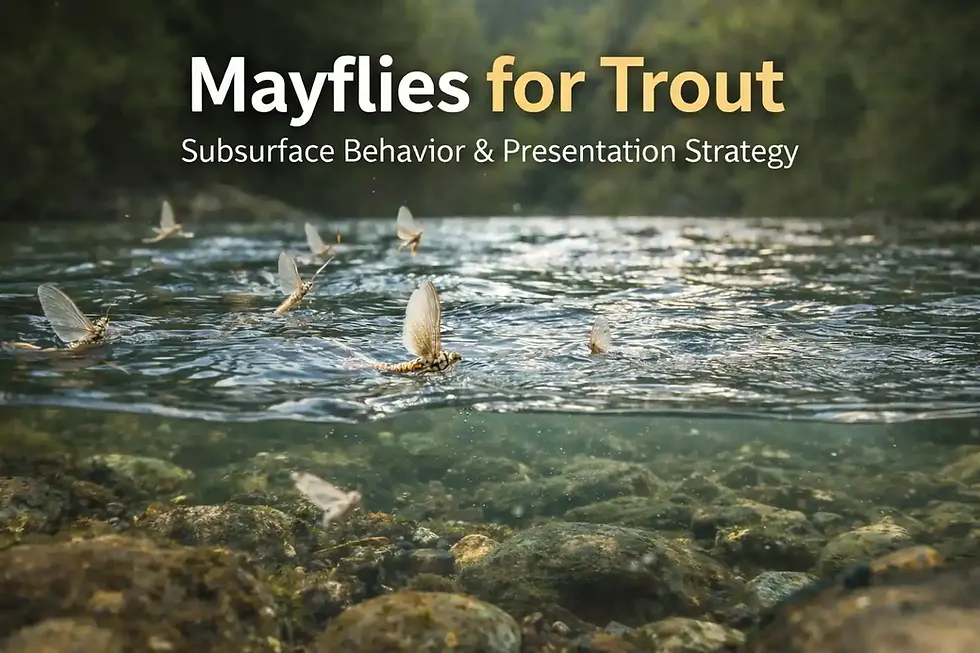
During emergence windows, larger dry fly patterns can imitate adult stoneflies skittering across the surface. Many rivers also see mayfly hatches during warmer months. Understanding the timing and behavior of these insects helps anglers match conditions more precisely. Our complete guide to mayflies for trout explains when and how trout feed during these important hatches. Seasonal variations matter:
• Early Black Stoneflies (size 14–18) hatch in late winter.
• Giant Salmonflies (size 4–8) dominate many rivers in late spring.
Regardless of pattern choice, success depends on matching depth, size, and natural drift rather than speed or flash.
Pro tip: Fish stonefly nymphs deep in riffles during non-hatch periods. Trout know they’re always there.

Subsurface Stoneflies for Spin Anglers
While fly anglers imitate stoneflies with weighted nymph patterns, the same subsurface principles apply to spin tackle.
Stonefly nymphs spend most of their lives crawling along the bottom in cold, oxygen-rich water. Trout feeding near rocks, current seams, and riffles often key in on compact, natural insect profiles rather than large reaction baits.
A properly weighted soft plastic stonefly imitation allows anglers to:
• Maintain bottom contact• Control drift speed through current• Match the natural size and silhouette of local nymphs• Present a subtle, realistic movement profile
When trout are pressured, holding tight to structure, or feeding subsurface outside of major hatches, a controlled bottom presentation frequently outperforms high-visibility lures.
For a complete breakdown of trout lure selection, color strategy, and presentation mechanics, read our Best Soft Plastics for Trout: Complete Guide to Color, Rigging & Performance.
6. Conservation Connection
Stoneflies are bioindicators—they disappear when rivers are polluted or oxygen levels drop. Their decline often signals trouble for the entire ecosystem. Anglers who value stonefly hatches are indirectly supporting clean water initiatives and habitat preservation.
7. Practical Angler’s Guide
• Gear: 4–6 weight rods handle stonefly patterns well.
• Presentation: Dead-drift nymphs near the bottom; skitter dry flies across the surface.
• Timing: Watch for hatches in late winter (small black stoneflies) and late spring (giant salmonflies).
• Observation: Flip over rocks—if you see stonefly nymphs, trout are eating them.
8. Beyond Trout: The Bigger Picture
While trout are the headline species, stoneflies also feed bass, panfish, and other river dwellers. Their role in the food chain is broader than most anglers realize. Protecting stoneflies means protecting entire aquatic communities.
9. Angler Responsibility
• Support river conservation groups.
• Practice catch-and-release to maintain healthy fish populations.
• Respect seasonal closures that protect spawning fish and insect cycles.

9. Frequently Asked Questions About Stoneflies and Trout
Do trout eat stoneflies year-round?
Yes. While adult stonefly hatches occur seasonally, trout feed on stonefly nymphs throughout the year. Most of the stonefly lifecycle is spent along the bottom, making subsurface presentations effective outside of hatch periods.
Where do stonefly nymphs live in a stream?
Stonefly nymphs typically live in cold, oxygen-rich water along rocky bottoms, riffles, and current seams. Trout often hold near these areas to feed on drifting nymphs.
Are stonefly imitations better in cold water?
Stonefly imitations are especially effective in cold water when trout are less aggressive and feeding closer to the bottom. Realistic subsurface profiles often outperform high-visibility reaction baits in these conditions.
What size stonefly works best for trout?
Stonefly size depends on the local species, but smaller nymph imitations often produce consistent results in clear or pressured water. Matching local insect size improves realism and strike consistency.
Conclusion: Understanding Stoneflies Improves Trout Success
Stoneflies are not just seasonal hatch events — they are a year-round subsurface food source for trout in cold, oxygen-rich systems. Most of their lifecycle is spent along the bottom, which is exactly where trout learn to look for them.
Whether you fish with fly tackle or spin gear, the principle remains the same: match the insect’s size, depth, and natural movement.
Stoneflies are only one part of the aquatic food chain. Other insects like mayflies often dominate trout diets during seasonal hatches. Learning how trout respond to different insects can dramatically improve success. Our mayflies for trout guide explains the lifecycle and fishing strategies for these important insects.
For spin anglers, a compact soft plastic stonefly imitation provides precise depth control, consistent bottom contact, and subtle presentation in technical water. When trout are pressured or holding tight to structure, realism and drift matter more than flash.
Understanding the biology behind stoneflies allows you to fish with intention rather than guesswork — and that consistency translates directly into more predictable trout results.

Comments