.webp)
A Complete System for Catching Stocked Trout Consistently (No Guesswork)
- Rodney Abel
- Apr 13
- 5 min read

Updated: 2 days ago
Part 7 — A Complete System for Consistently Catching Stocked Trout
A Condition-Based Framework for Decision Making
1. The Objective: Eliminate Guesswork
At this point, all key variables have been defined:
What trout recognize as food
How they detect it
Where they position
When they feed
How they adapt
Core Principle
Consistent results come from applying the correct variables in the correct order.
This section converts all prior information into a repeatable system.
For a complete breakdown of bait selection, color, rigging, and performance, see Best Soft Plastics for Trout: Complete Guide to Color, Rigging & Performance.
2. The Five Variable Model

Every trout fishing situation can be broken into five variables:
Time Since Stocking
Water Conditions
Fish Location
Feeding Activity Level
Fishing Pressure
Priority Order
Always evaluate in this order:
1 → 2 → 3 → 4 → 5
Skipping order leads to incorrect decisions.

3. Step 1 — Time Since Stocking
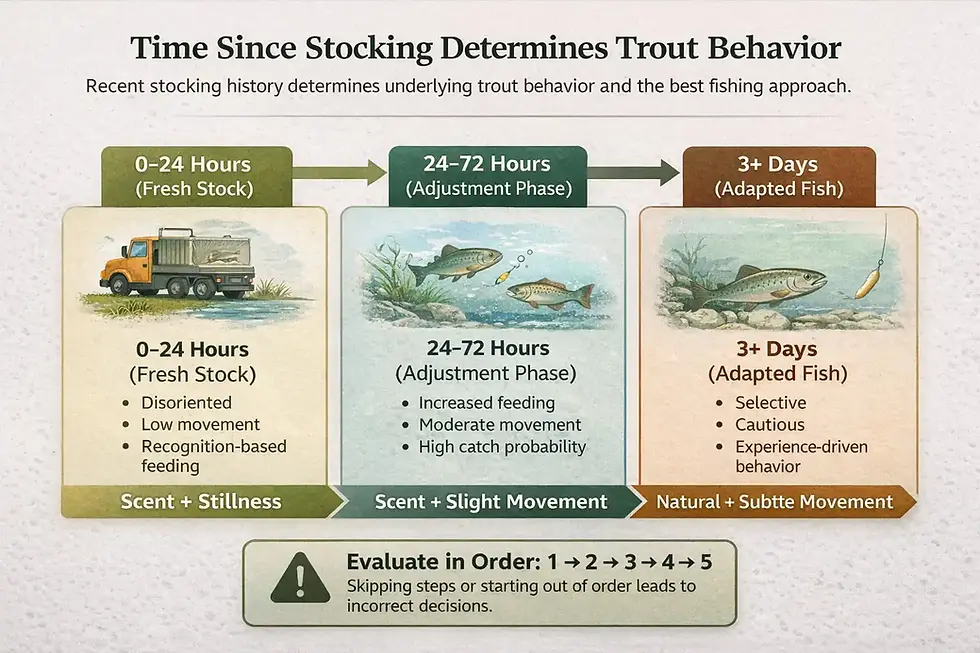
Categories
0–24 Hours (Fresh Stock)
Disoriented
Low movement
Recognition-based feeding
24–72 Hours (Adjustment Phase)
Increased feeding
Moderate movement
High catch probability
3+ Days (Adapted Fish)
Selective
Cautious
Experience-driven behavior
Required Adjustment
Stage | Strategy |
Fresh | Scent + stillness |
Adjustment | Scent + slight movement |
Adapted | Natural + subtle movement |
4. Step 2 — Water Conditions

Evaluate Three Factors
1. Clarity
Clear → vision dominant
Murky → scent dominant
2. Light
Bright → cautious behavior
Low light → increased feeding
3. Temperature
Cold → slow movement
Moderate → increased activity
Output Decision
This step determines:
Scent strength
Color choice
Movement level
Choosing the correct bait based on these conditions is critical. See how to match trout expectations in Best Soft Plastics for Trout: Complete Guide to Color, Rigging & Performance.
Bait design plays a critical role in how trout respond under different conditions. See how we build effective baits in How We Design Our Plastics.
5. Step 3 — Fish Location

Initial Positioning
Start with:
Stocking point
Shoreline zones
Shallow to mid-depth
Adjust Based on Behavior
If no bites:
Change depth first
Then change distance
Then relocate
Location Rule
Depth adjustment is more effective than location change early.
6. Step 4 — Feeding Activity Level

Identify Activity
Active Fish
Multiple bites
Visible movement
Neutral Fish
Occasional bites
Inconsistent response
Inactive Fish
No bites
Fish visible but not feeding
Adjustment
Activity | Strategy |
Active | Maintain approach |
Neutral | Reduce movement |
Inactive | Increase scent, slow down |
7. Step 5 — Fishing Pressure
Indicators of Pressure
Crowded shoreline
Repeated casting
Declining bite rate
Behavioral Effect
Fish relocate
Become selective
Reduce feeding windows
Adjustment
Move away from pressure
Downsize bait
Increase realism
8. The Decision Flow (Full System)
Step-by-Step Execution
Step 1 — Identify Stocking Stage
→ Determines base strategy
Step 2 — Evaluate Water Conditions
→ Determines sensory trigger (scent vs vision vs vibration)
Step 3 — Set Initial Location
→ Shoreline, shallow, stocking zone
Step 4 — Set Depth
→ Start shallow → adjust deeper
Step 5 — Choose Presentation
→ Match stage + conditions
Small, natural-profile baits like a round worm soft plastic trout lure are especially effective when trout become selective and require subtle, natural presentation.
Step 6 — Observe Feedback
→ Bites, follows, inactivity
Step 7 — Adjust One Variable at a Time
Depth
Movement
Location
Bait
9. Scenario-Based Applications
Scenario 1 — Freshly Stocked Pond, Clear Water
Conditions:
12 hours post-stocking
Clear water
Light fishing pressure
Strategy
Bait: dough bait
Scent: strong
Movement: none
Depth: 1–3 feet
Location: near stocking point
Scenario 2 — 2 Days After Stocking, Light Wind
Conditions:
Moderate clarity
Increasing fish activity
Strategy
Bait: scent + small lure combination
Movement: slow retrieve
Depth: mid-column
Location: expanding away from stocking point
Scenario 3 — 5 Days After Stocking, High Pressure
Conditions:
Clear water
Heavy fishing pressure
Strategy
Bait: small, natural
Movement: subtle
Depth: varied
Location: low-pressure areas
10. Adjustment Hierarchy
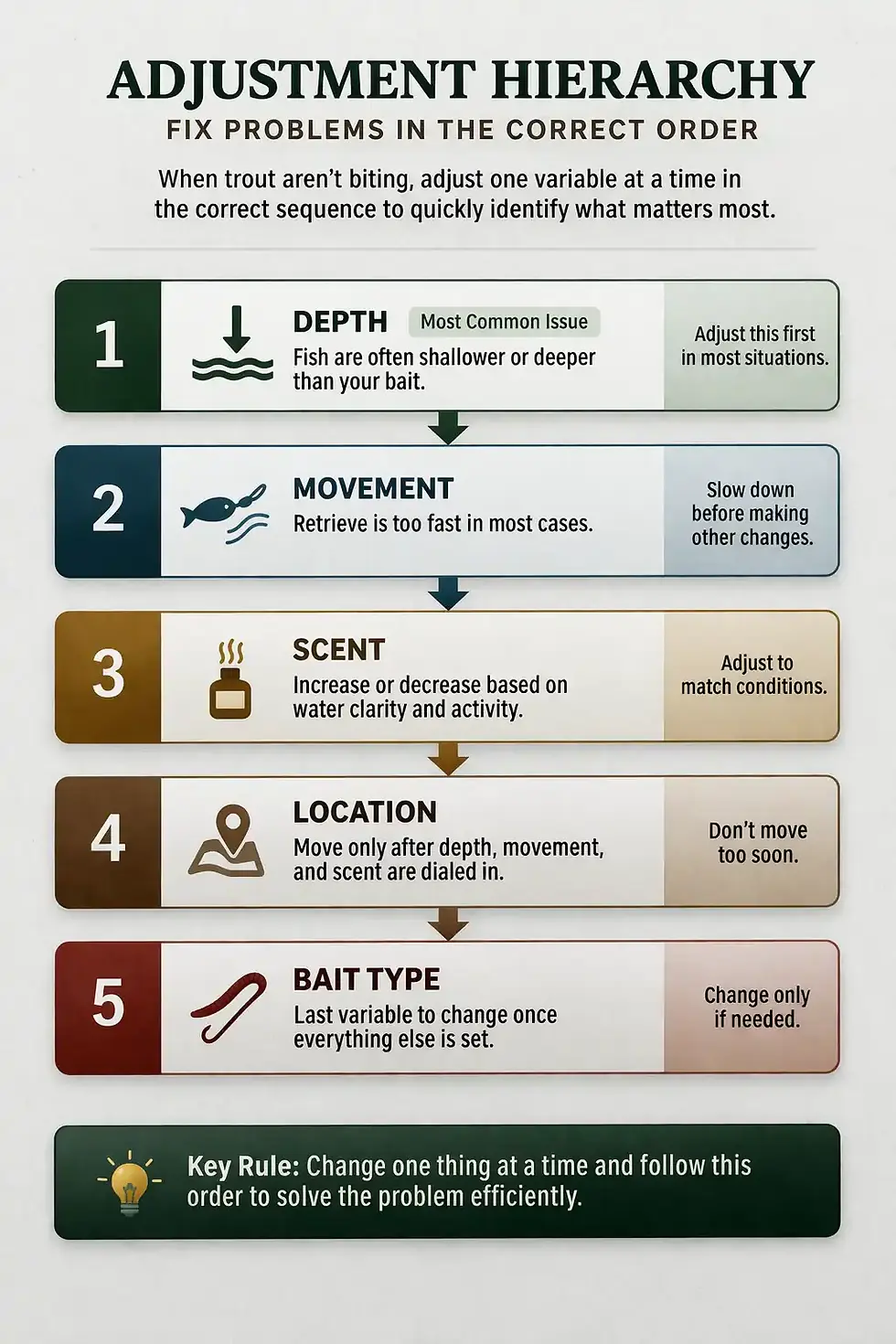
When fish are not biting, adjust in this order:
1. Depth
Most common issue
2. Movement
Too fast in most cases
3. Scent
Increase or decrease
4. Location
Move only after other adjustments fail
5. Bait Type
Last variable to change
11. Efficiency System
Goal
Maximize catch rate per unit of time.
Key Rules
Do not change multiple variables at once
Do not abandon productive areas too quickly
Do not overcomplicate bait selection
Time Management
Give each setup adequate time
Adjust methodically
Track what works
12. Common Failure Patterns
1. Random Changes
No structured approach
2. Over-Reliance on Lures Early
Ignoring trout conditioning
3. Ignoring Conditions
Using same setup in all environments
4. Fishing Too Fast
Most anglers move bait excessively
5. Poor Depth Control
Most common failure point
13. Key Takeaways
Trout behavior follows predictable patterns
Success depends on matching conditions, not guessing
Time since stocking determines baseline behavior
Water conditions determine sensory triggers
Depth and location determine opportunity
Small adjustments produce significant results
Final System Summary
Input Variables
Stocking stage
Water clarity
Light conditions
Temperature
Pressure
Output Decisions
Bait type
Scent level
Movement
Depth
Location
Execution Model
Identify conditions
Select strategy
Apply consistently
Observe feedback
Adjust systematically

Series Conclusion
This system removes reliance on:
Trial-and-error fishing
Random bait changes
Unstructured decision-making
It replaces them with:
Condition-based logic
Behavioral understanding
Repeatable results
For the complete trout fishing system, including bait selection and presentation, visit:
Result
Consistent catch rates across:
Different waters
Different stocking schedules
Different pressure levels
Stocked Trout Fishing FAQ
Q1:
Why am I not catching stocked trout even when I see them?
Answer: Stocked trout may be present but not actively feeding. This usually means your presentation does not match their current behavior. Adjust depth first, then movement, then scent before changing bait.
Q2:
What is the best time to catch stocked trout?
Answer: The highest catch rates typically occur 24–72 hours after stocking, especially during early morning and evening when light levels are lower and trout are more active.
Q3:
Should I use bait or lures for stocked trout?
Answer: Use bait immediately after stocking when trout rely on scent. As fish adapt over several days, lures and subtle movement become more effective.
Q4:
How deep should I fish for stocked trout?
Answer: Start shallow (1–4 feet) and adjust depth incrementally. Most anglers fish too deep too early, while stocked trout often suspend in the water column.
Q5:
Why do stocked trout stop biting after a few days?
Answer: Trout quickly learn from fishing pressure and begin rejecting unnatural presentations. They become more selective and require smaller, more natural bait with subtle movement.
Q6:
What is the most important factor in catching stocked trout consistently?
Answer: Matching your strategy to time since stocking and current conditions. Consistent success comes from adjusting depth, movement, and presentation in the correct order—not guessing.
Previous Article: How Trout Behavior Changes After the First Week
Continue Learning
Explore the full system and expand your trout fishing strategy:


Comments