.webp)
Where Stocked Trout Actually Feed
- Rodney Abel
- Apr 6
- 5 min read

Updated: Apr 8
Part 4 — Where Stocked Trout Actually Feed
Positioning, Depth, and Movement Patterns That Control Catch Rates
To understand where stocked trout position, you need to understand how they detect food. If you missed it, read How Stocked Trout Find Food before continuing.
This article is part of our complete trout system. For the full breakdown, see our Best Soft Plastics for Trout: Complete Guide to Color, Rigging & Performance.
1. Where Stocked Trout Feed Controls Everything
Feeding behavior is irrelevant if the bait is not placed where trout are holding.
Stocked trout do not distribute evenly. They concentrate based on:
Release point
Comfort zones
Environmental conditions
Core Principle
Most anglers fail because they fish where trout are not.
2. The Stocking Point Effect
Initial Distribution Pattern
After stocking, trout do not immediately disperse. They form a concentration zone near:
The release site
Shoreline entry points
Low-current areas

Why This Happens
Disorientation limits movement
Energy conservation reduces travel
Group behavior keeps fish clustered
Practical Application
First 24–48 Hours
Fish:
Within visible range of stocking areas
Along the nearest shoreline
In shallow to mid-depth zones
Common Mistake
Mistake: Spreading out immediately across the entire body of water
Reality: Fish are concentrated in a small area
Adjustment:
Start at stocking zones
Expand outward only after bite slows
3. Shoreline Bias

Key Behavior
Stocked trout show a strong tendency to remain near shore early on.
Reasons
Hatchery environments are confined
Shoreline provides reference structure
Shallow water feels “contained”
Distance from Shore
Typical holding range:
5–30 feet from bank
Practical Application
Casting Strategy
Do not cast maximum distance
Fish short to medium range
Cast parallel to shoreline when possible
Common Mistake
Mistake: Casting past fish
Reality: Bait lands beyond active zone
Adjustment:
Reduce casting distance
Work closer water first
4. Depth Control: Most Fish Are Not on Bottom
Early Depth Behavior
Stocked trout tend to:
Suspend in the water column
Avoid extreme depths initially

This directly ties into how trout detect food. If you understand how their senses work, depth control becomes predictable. See How Stocked Trout Find Food.
Why They Suspend
Oxygen familiarity (surface-fed in hatchery)
Light orientation
Reduced pressure compared to deep water
Practical Depth Zones
Early Stage
1–4 feet below surface
Mid-column suspensions
Transition Stage
Gradual movement deeper
Increased bottom interaction
Practical Application
Bait Fishing
Use floating bait
Adjust leader length to suspend bait
Float Fishing
Start shallow
Increase depth incrementally
Common Mistake
Mistake: Fishing directly on the bottom by default
Reality: Fish are often above the bait
Adjustment:
Raise bait in the water column
Test multiple depths
5. Movement Patterns: Holding vs Cruising
Two Primary Behaviors
1. Holding
Fish remain in a fixed position
Minimal movement
Waiting for food
2. Cruising
Fish move slowly through an area
Searching or exploring

Early-Stage Behavior
More holding than cruising
Short, slow movement bursts
Transition Behavior
Increased cruising
Wider movement range
Practical Application
When Fish Are Holding
Keep bait stationary
Place bait directly in holding zone
Matching depth and presentation only works if your bait is designed correctly. See how we build baits specifically for trout behavior in How We Design Our Plastics.
When Fish Are Cruising
Cover water slowly
Use slight movement to trigger strikes
Key Indicator
If bites are inconsistent:
Fish are likely cruising
If bites occur repeatedly in one spot:
Fish are holding
6. Current vs Still Water Behavior
Still Water (Ponds, Lakes)

Trout suspend or cruise slowly
Movement is unpredictable
Positioning depends on comfort zones
Moving Water (Stocked Streams)
Trout face upstream
Hold in slower current breaks
Use current to bring food
Practical Application
Still Water Strategy
Focus on location and depth
Minimal movement
Moving Water Strategy
Cast upstream or across current
Let bait drift naturally
Common Mistake
Mistake: Fishing fast current directly
Reality: Trout avoid high-energy zones
Adjustment:
Target edges of current
Fish slower seams
7. Structure: Less Important Early, More Important Later
Early Stage
Stocked trout:
Do not immediately relate to structure
Prioritize comfort over cover
Later Stage
Trout begin using:
Drop-offs
Rocks
Vegetation
Shade lines

Practical Application
Early Fishing
Focus on open water near stocking zones
Later Fishing
Transition to structure-based targeting
Common Mistake
Mistake: Fishing structure immediately after stocking
Reality: Fish have not moved there yet
Adjustment:
Delay structure-focused fishing
8. Pressure-Induced Movement
Effect of Fishing Pressure
Trout respond quickly to:
Noise
Repeated casting
Hooking pressure
Behavioral Shift
Fish begin to:
Move away from high-traffic areas
Hold in less accessible zones
Reduce surface activity

This is why understanding trout behavior matters more than lure choice. Most anglers never adjust. If you missed the behavior breakdown, go back to How Stocked Trout Find Food.
Practical Application
After Day 1
Move away from main access points
Fish less obvious areas
Target edges of pressure zones
Common Mistake
Mistake: Staying in crowded areas
Reality: Fish relocate quickly
Adjustment:
Prioritize low-pressure water
9. Environmental Positioning Factors
Light
Bright Conditions
Fish move slightly deeper
Avoid direct sunlight
Low Light
Fish move shallower
Increase movement
Wind
Wind pushes:
Surface food
Oxygen-rich water
Practical Use
Fish wind-blown shorelines
Target areas where water is moving
Temperature
Cold Water
Fish hold tighter
Reduced movement
Warmer Water
Increased cruising
Wider distribution

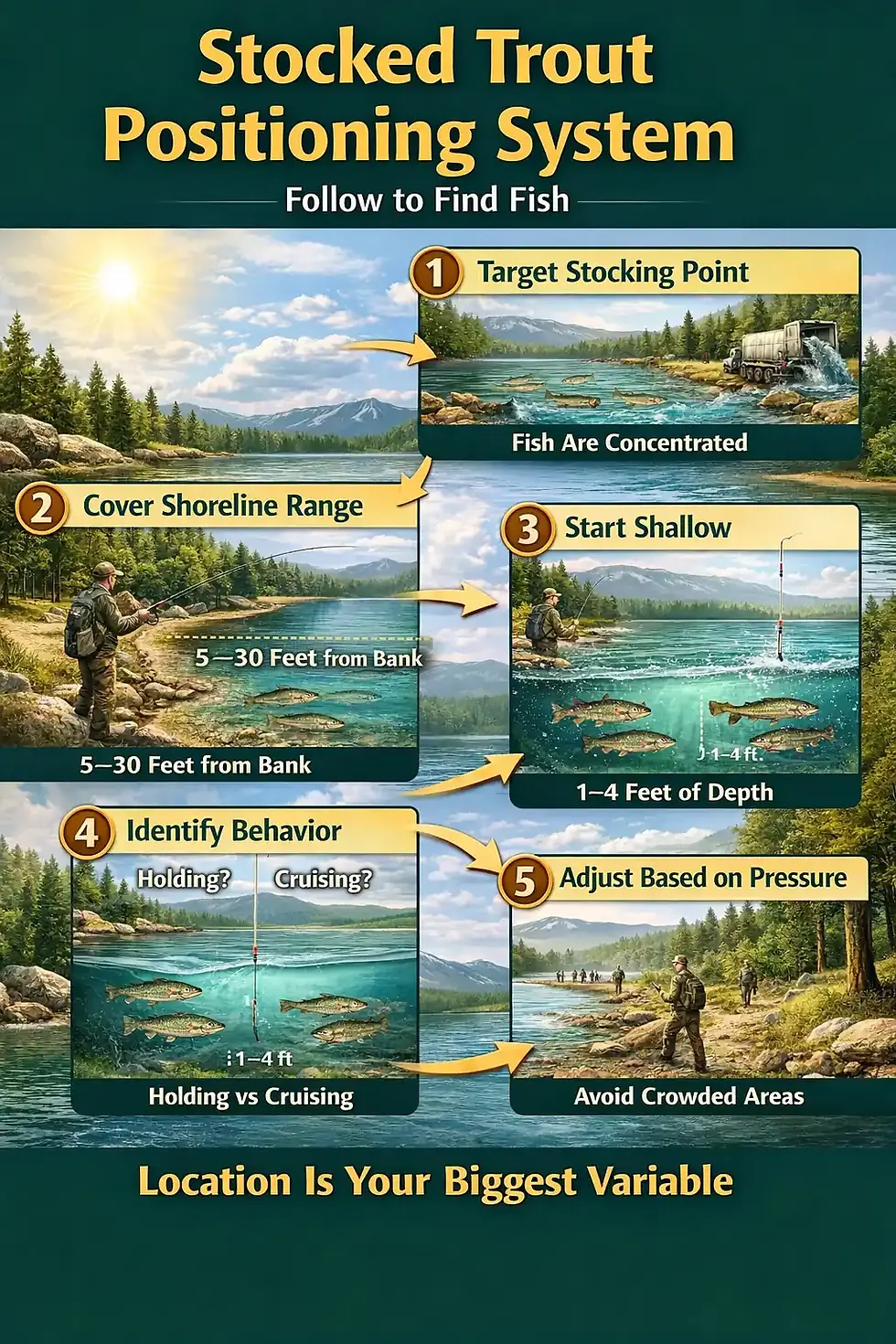
10. Positioning System
Step 1 — Start at Stocking Point
Fish concentrated zones first
Step 2 — Work Shoreline Range
5–30 feet from bank
Step 3 — Adjust Depth
Start shallow
Move deeper only if needed
Step 4 — Identify Behavior
Holding vs cruising
Step 5 — Adjust Location Based on Pressure
Move away from crowds
Target less obvious areas
11. Common Failure Points
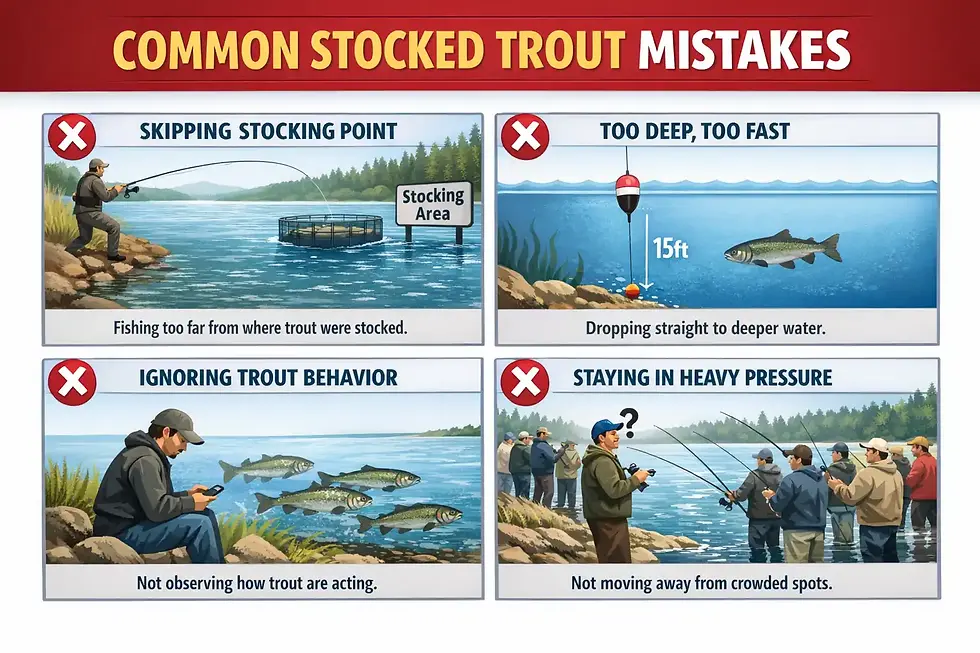
1. Fishing Too Far Out
Fish are closer than expected
2. Fishing Too Deep Too Soon
Trout are suspended early
3. Ignoring Stocking Location
Leads to low fish density
4. Staying Static Too Long
Fish may have moved
12. Key Takeaways
Stocked trout are location-dependent, not evenly distributed
Early fish concentrate near stocking points and shorelines
Most fish are suspended, not on the bottom
Movement patterns shift from holding to cruising over time
Fishing pressure rapidly changes positioning

What This Means Going Forward
You now understand how stocked trout behavior is controlled by three key variables:
What trout recognize as food (Part 2)
How trout detect bait (Part 3)
Where trout position themselves to feed (Part 4)
When these are aligned, fishing becomes predictable instead of random.
Continue the System
Build the Complete Trout System
For the full breakdown of bait selection, presentation, and performance: Best Soft Plastics for Trout: Complete Guide to Color, Rigging & Performance


Comments