.webp)
Best Trout Worm Sizes (When Size Matters)
- Rodney Abel
- Apr 29
- 5 min read

Choosing the best trout worm size is one of the most overlooked decisions in fishing.
Most anglers focus on:
color
jig head weight
retrieve speed
But ignore a variable that directly affects whether trout commit or refuse:
the size and profile of the bait
When trout worm size is wrong:
trout may follow but not bite
strikes become inconsistent
fish inspect but reject the bait
Understanding how trout respond to size allows you to adjust presentation and increase strike conversion.
This guide is part of a complete trout fishing system that explains how size, fall rate, speed, and visibility work together.
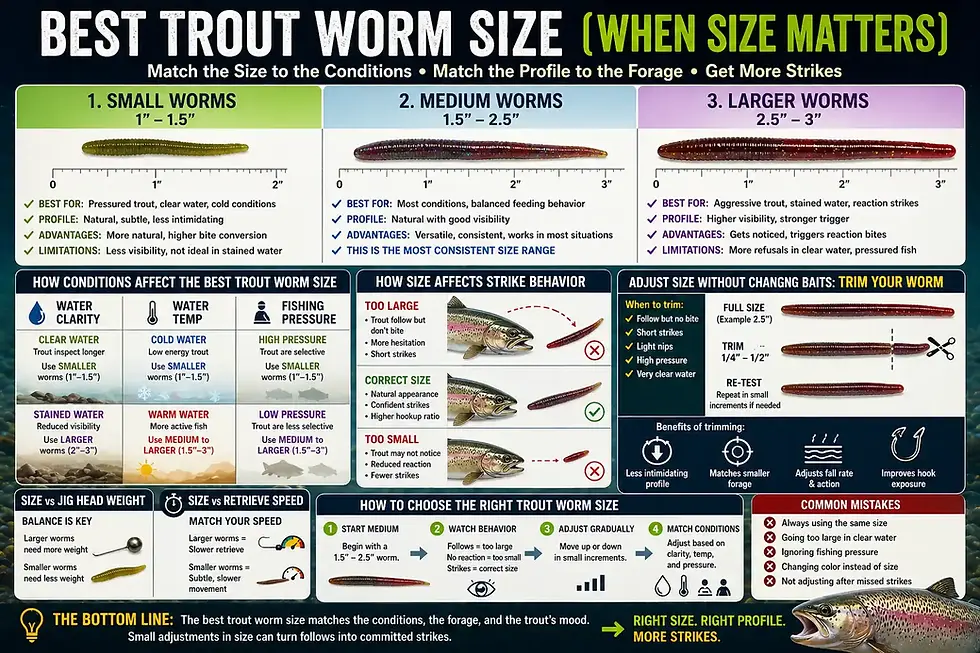
Why Trout Worm Size Matters
Trout do not evaluate bait randomly.
They respond to size based on:
available forage
water clarity
pressure
energy efficiency
If the bait is too large:
trout hesitate
increased inspection
more refusals
If the bait is too small:
reduced visibility
fewer reaction strikes
Correct size:
matches expectation
increases confidence
improves commitment
How to Choose the Best Trout Worm Size for Different Conditions
1. Small Worms (1" – 1.5")
Best for:
pressured trout
clear water
cold conditions
Advantages:
natural profile
less intimidating
higher bite conversion
Limitations:
reduced visibility
less effective in stained water
2. Medium Worms (1.5" – 2.5")
Best for:
most conditions
balanced feeding behavior
Advantages:
good visibility
natural presentation
versatile
This is the most consistent size range for trout fishing.
3. Larger Worms (2.5" – 3")
Best for:
aggressive trout
stained water
reaction strikes
Advantages:
higher visibility
stronger trigger
Limitations:
increased rejection in pressured fish
less natural in clear water
How Trout Worm Size Affects Strike Behavior
Too Large
trout follow but don’t bite
increased hesitation
short strikes
Too Small
trout may not notice
reduced reaction
Correct Size
natural appearance
confident strikes
higher hookup ratio
How Water Conditions Change Worm Size Selection
Clear Water
trout inspect longer
prefer subtle presentations
Use:
smaller worms
natural profiles
Stained Water
reduced visibility
Use:
slightly larger worms
stronger profile
Cold Water
low energy trout
Use:
smaller sizes
easier to commit
Warm Water
more active fish
Use:
medium to larger sizes
increased visibility
How Fishing Pressure Affects Size
High Pressure
trout become selective
reject unnatural size
Best approach:
downsize
simplify profile
Low Pressure
trout react aggressively
Best approach:
medium or larger worms
stronger visual presence
Trout Worm Size vs Jig Head Weight
Size and weight must work together.
larger worms + heavy weight → unnatural fall
smaller worms + light weight → natural drift
Correct balance:
keeps bait in strike zone
maintains natural presentation
Trout Worm Size vs Retrieve Speed
Size changes how speed is perceived.
larger worms require slower retrieve
smaller worms allow subtle movement
If speed is correct but fish still won’t commit:
size may be the problem
How to Choose the Right Trout Worm Size (Step-by-Step)
Step 1 — Start Medium
Begin with a 1.5"–2.5" worm.
Step 2 — Watch Trout Behavior
follows → size may be too large
no reaction → size may be too small
strikes → size is correct
Step 3 — Adjust Gradually
Do not make large jumps.
Move up or down in small increments.
Step 4 — Match Conditions
Adjust size based on:
clarity
temperature
pressure
Adjusting Trout Worm Size Without Changing Baits
One of the most effective but overlooked techniques in trout fishing is adjusting worm size without switching lures.
Instead of constantly changing baits:
you can simply shorten the worm to match conditions
This allows you to fine-tune presentation without disrupting your setup.
Why Trimming a Trout Worm Works
Trout respond to profile more than anglers realize.
By reducing worm length:
the bait becomes less intimidating
the profile matches smaller forage
strike hesitation decreases
This is especially effective when:
trout are following but not biting
fish are pressured
water is clear
When You Should Shorten a Worm
Trim your worm when you notice:
trout following but refusing
short strikes
light bites without commitment
increased fishing pressure
In these situations:
the bait is often slightly too large—not completely wrong
How to Trim a Trout Worm (Step-by-Step)
Step 1 — Start Full Size
Fish the worm in its original length first.
Step 2 — Identify the Problem
If trout:
follow but don’t commit
nip at the tail
Then size is likely too large.
Step 3 — Remove a Small Section
Tear or cut off:
1/4" to 1/2" at a time
Do NOT over-adjust.
Step 4 — Re-test Presentation
Fish the same way after trimming.
Watch for:
faster strikes
fewer refusals
Step 5 — Repeat if Needed
Continue adjusting in small increments until:
trout commit confidently
How Trimming Changes Performance
Shortening a worm affects more than just size.
It also changes:
fall rate (slightly faster)
movement (tighter action)
hook exposure (often improved)
This can increase:
hookup ratio
strike conversion
Trimming vs Switching Baits
Most anglers make this mistake:
immediately changing color or lure
Instead:
adjust size first
Trimming allows you to:
stay in the same presentation
isolate the problem
make precise adjustments
Common Mistakes When Trimming Worms
Avoid:
removing too much at once
trimming before testing original size
ignoring how trimming affects fall rate
switching lures too quickly instead of adjusting
Common Mistakes
Avoid:
always using the same size
going too large in clear water
ignoring pressure
changing color instead of size
not adjusting after missed strikes
The Real Pattern
Most anglers assume color is the problem.
In reality:
size and profile determine whether trout commit
If trout are following but not biting:
size is often too large
If trout are not reacting:
size may be too small
Final Breakdown
Correct trout worm size:
matches forage
fits conditions
improves confidence
This leads to:
fewer refusals
more committed strikes
better overall results
Summary
Trout worm size is not a minor detail—it is a primary decision variable.
Too large:
hesitation
rejection
Too small:
reduced visibility
Correct size:
natural presentation
consistent strikes
In many cases, you don’t need a different bait—you just need a different size. Trimming a worm can turn hesitation into confident strikes without changing your setup.
To understand how bait size fits into the full approach, see the


Comments