.webp)
How Water Clarity Affects Trout Fishing (And How Trout See Your Lure)
- Rodney Abel
- Apr 29
- 3 min read

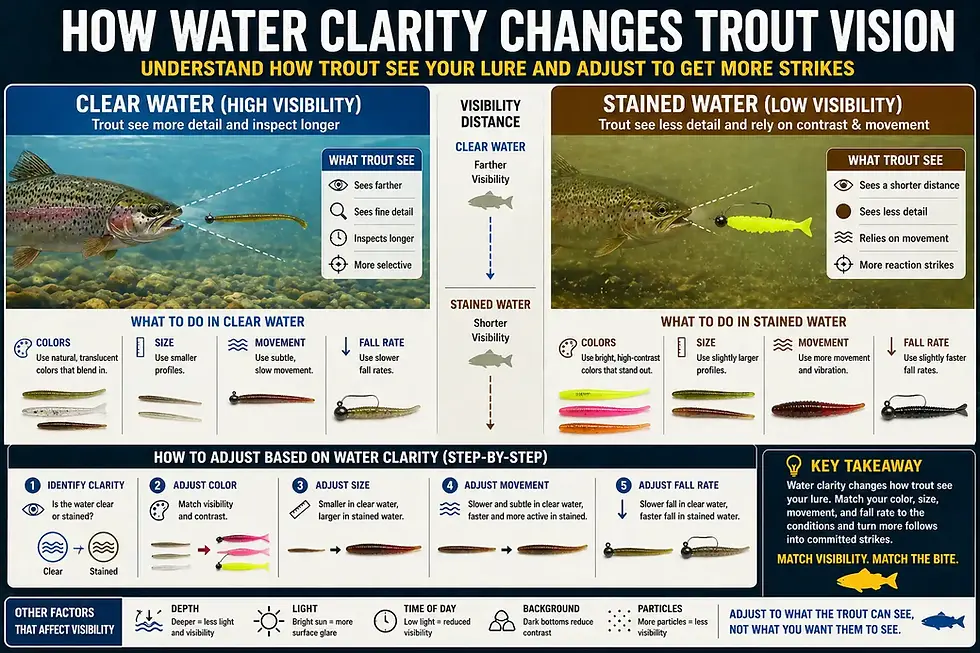
Understanding how water clarity affects trout fishing is critical because it determines how trout see your lure and whether they commit or refuse.
Water clarity is one of the most important factors in trout fishing.
It directly controls:
how trout see your bait
how long they inspect it
whether they commit or refuse
Most anglers adjust color randomly.
But the correct approach is:
understand how water clarity changes trout vision—and adjust presentation accordingly
When you do this correctly:
your bait becomes visible at the right distance
your presentation looks natural
trout commit instead of following
This guide is part of a complete trout fishing system that explains how visibility, size, fall rate, and movement work together.
How Water Clarity Affects Trout Fishing
Trout rely heavily on sight.
But what they see changes based on:
light penetration
suspended particles
depth
background contrast
As water clarity changes:
colors shift
visibility range changes
detail perception increases or decreases
This directly affects how trout respond to your bait.
Clear Water: High Visibility, High Inspection
What Trout See
In clear water:
trout see farther
trout detect fine details
trout inspect longer
This makes them more selective.
Common Mistake
Using:
bright colors
oversized baits
unnatural movement
These stand out too much.
Best Approach
In clear water:
use natural, translucent colors
reduce size and profile
slow down presentation
Why This Works
In high visibility:
trout reject anything that looks unnatural
Stained Water: Reduced Visibility, Increased Reaction
What Trout See
In stained water:
visibility distance is reduced
detail is limited
contrast becomes more important
Trout rely more on:
silhouette
movement
vibration
Common Mistake
Using:
subtle, natural colors
These become invisible.
Best Approach
In stained water:
increase contrast
use brighter colors
slightly increase bait size
Why This Works
In low visibility:
trout need to detect your bait before they can evaluate it
How Water Clarity Changes Strike Behavior
Clear Water Behavior
trout follow longer
trout inspect closely
more refusals
Stained Water Behavior
trout react faster
less inspection
more reaction strikes
How Depth Affects Visibility
Even in clear water, depth reduces visibility.
As depth increases:
light decreases
colors fade
contrast becomes critical
Key pattern:
red disappears first
darker tones remain visible longer
This means:
deeper water often behaves like stained water
How to Adjust Based on Water Clarity (Step-by-Step)
Step 1 — Identify Clarity
clear → high visibility
stained → low visibility
Step 2 — Adjust Color
clear water → natural, translucent
stained water → bright, high contrast
Step 3 — Adjust Size
clear water → smaller
stained water → larger
Step 4 — Adjust Movement
clear water → subtle
stained water → more aggressive
Step 5 — Adjust Fall Rate
clear water → slower
stained water → slightly faster
Water Clarity vs Lure Material
Clear Water
Best:
marabou
soft plastics with subtle movement
Stained Water
Best:
soft plastics
stronger profiles
Common Mistakes
Avoid:
using bright colors in clear water
using subtle colors in stained water
ignoring depth changes
adjusting only one variable (color) instead of the full system
The Real Pattern
Most anglers think:
color is the main factor
In reality:
water clarity determines how trout see everything
If trout are:
following but not striking → too visible / unnatural
not reacting → not visible enough
Final Breakdown
Clear water:
high visibility
high inspection
requires precision
Stained water:
low visibility
fast reactions
requires contrast
Correct adjustment:
matches trout vision
increases confidence
improves strike conversion
Summary
Water clarity changes how trout see your bait—and how they decide to strike.
Clear water:
subtle
natural
precise
Stained water:
visible
bold
high contrast
When you understand how water clarity changes trout vision:
you stop guessing color and start controlling visibility
To understand how water clarity fits into the full approach, see the



Comments